
Westmoreland County Court Dockets
A court docket is the case's chronological index. It shows when the case was filed, which court has it, who the parties are, what events have occurred, and what future events may be scheduled. In Westmoreland County, public dockets can include civil, family, criminal, traffic, non-traffic summary, landlord-tenant, small claims, and preliminary criminal proceedings. The docket helps answer a narrow question: what has happened in the case record so far?
The full case file can be broader. A civil file may include pleadings, exhibits, orders, or scanned images through the Prothonotary's systems. A public criminal docket sheet on UJS may list charges, pleas, hearings, sentences, and financial balances, but it usually does not supply every underlying PDF. For a broader explanation of all file types, see Westmoreland County court records.
| Item | Docket | Full Case Record |
|---|---|---|
| Format | Chronological event list | Documents, docket, orders, images, and case data where available |
| Best use | Track status and hearings | Review filings, certified copies, and complete case history |
| Common access | UJS, iJEMS, or office search | Custodian office, public terminals, online images, or copy request |
Search Westmoreland County Court Dockets
The main statewide docket channel is UJS Case Search. UJS states that public web docket sheets let users search, view, and print dockets for appellate courts, Criminal Courts of Common Pleas, Magisterial District Courts, and Philadelphia Municipal Court. Westmoreland County criminal cases and MDJ cases are searched there. Civil and family Court of Common Pleas records are searched through the Prothonotary's iJEMS portal.
- Open UJS Case Search for criminal, MDJ, summary, traffic, or appellate docket sheets, or open iJEMS for civil and family docket access.
- Choose the court type. For Westmoreland County criminal cases, select Criminal Courts of Common Pleas; for lower-court matters, choose Magisterial District Courts.
- Enter a docket number, OTN, complaint number, citation number, party name, or date range. A docket number is the cleanest search key.
- Open the docket sheet and review the header, party section, charge or claim section, docket entries, disposition, and financial events.
- If the docket is missing, check whether the case is recent, sealed, limited access, older than the index, or filed in the wrong court level.
The manifest source for the public docket search screen is the official UJS public docket search.
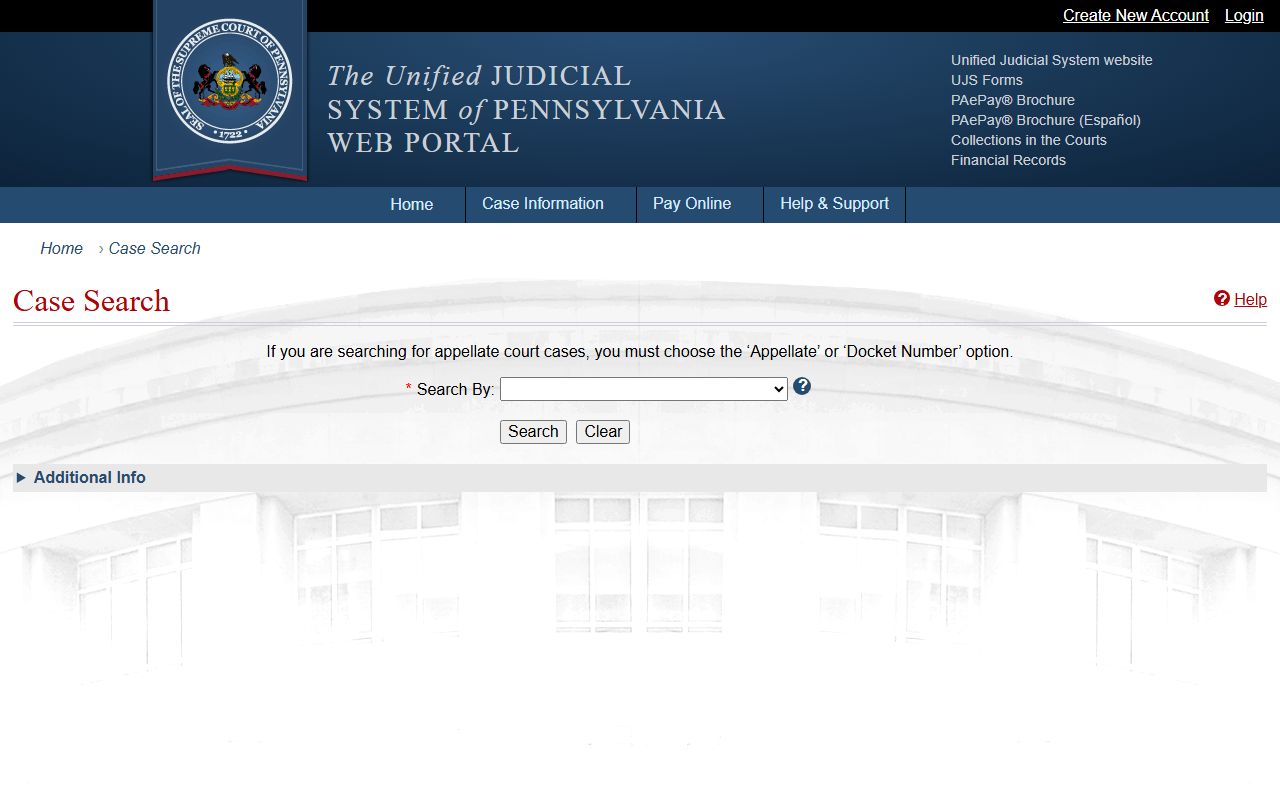
That public search is the route for many Westmoreland County court dockets, but civil and family docket work still belongs with the Prothonotary channel.
Westmoreland County Docket Fields
A docket sheet should be read from the top down. The header confirms the court, docket number, case type, filing date, status, judicial district, and judge when available. Party rows identify the plaintiff, defendant, Commonwealth, attorney, agency, or police department. Event rows then create the case timeline.
| Field | What It Shows |
|---|---|
| Docket number | The unique case number, often CP-65-CR for Common Pleas criminal cases or an MJ pattern for Magisterial District Court. |
| Case status | Active, closed, disposed, appealed, limited access, or another status shown by the court system. |
| Event date | The date of a filing, hearing, order, continuance, payment, bench warrant, plea, sentencing, or other docket activity. |
| Event type | The court action, such as preliminary hearing, formal arraignment, motion, order, guilty plea, ARD, or sentencing. |
| Party or agency | The person, prosecutor, attorney, police agency, or office linked to the entry when displayed. |
| Financial entry | Fines, costs, restitution, payment plan, balance, and PAePay eligibility where UJS exposes that data. |
The judiciary's docket sheets page is the manifest source for docket-sheet access rules and timing cautions.
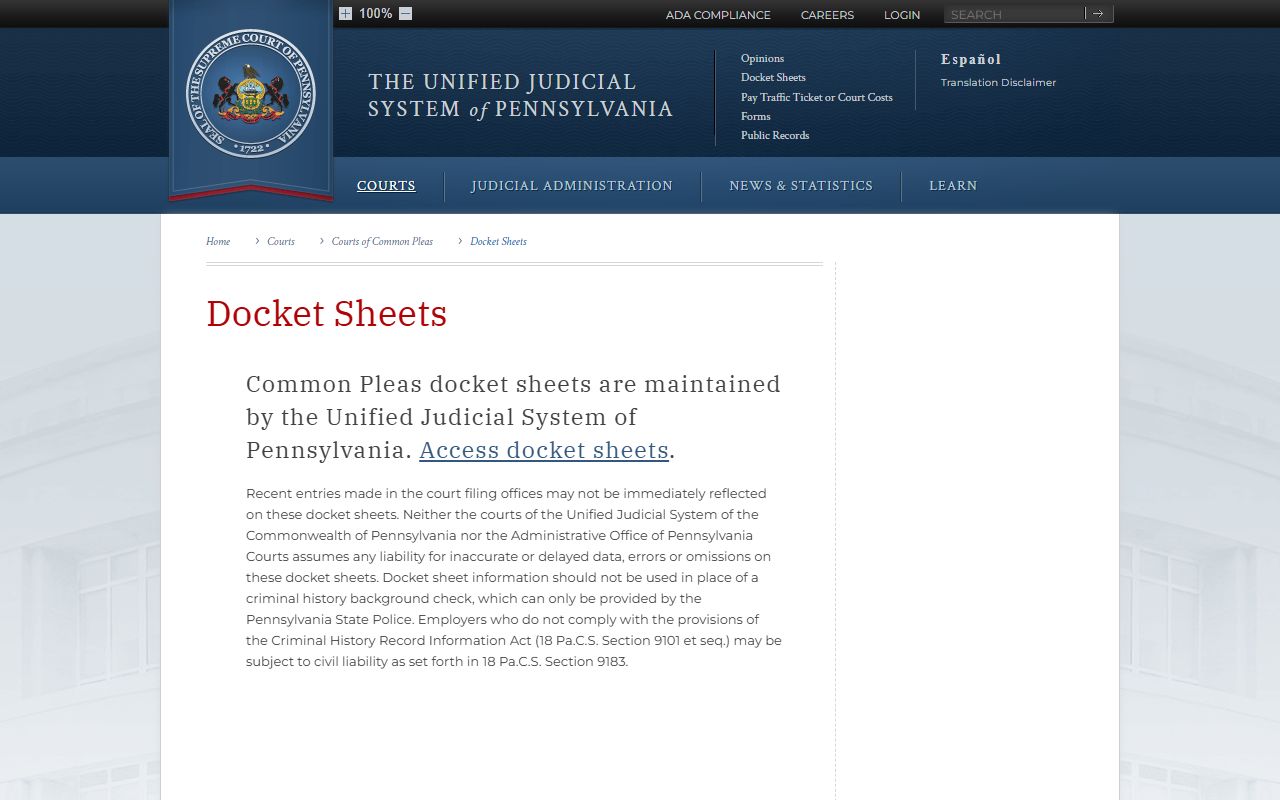
UJS warns that recent entries may not be reflected right away, so a docket sheet should be checked against the court office when timing is critical.
Westmoreland County Courts With Dockets
Westmoreland County's Court of Common Pleas is the general trial court. It handles felony criminal cases after preliminary proceedings, civil actions, family cases, divorce, custody, protection-from-abuse matters, juvenile proceedings, and Orphans' Court matters. Magisterial District Courts handle the first local layer for traffic citations, non-traffic summary cases, landlord-tenant claims, small civil claims, preliminary arraignments, and preliminary hearings.
- Court of Common Pleas criminal dockets are public through UJS when not restricted or limited access.
- Civil and family dockets are maintained by the Prothonotary and searched through iJEMS or office terminals.
- Magisterial District Court dockets appear in UJS for traffic, summary, landlord-tenant, small claims, and preliminary criminal matters.
- Orphans' Court docket access is tied to the Register of Wills and Clerk of the Orphans' Court, especially for estates and guardianships.
Westmoreland County has a practical cross-court issue in criminal matters. A single incident may begin at an MDJ docket for preliminary arraignment or preliminary hearing, then move to a Court of Common Pleas criminal docket after waiver or hearing disposition. Search both court levels when tracking a charge from arrest through final case outcome.
Traffic and summary dockets can have a similar venue issue. A payment result in PAePay may point back to a specific MDJ court, while the docket sheet in UJS gives the citation or summary case timeline. Landlord-tenant and small civil claims also stay at the Magisterial District Court level unless an appeal or related filing moves the dispute to the Court of Common Pleas. When a docket number starts with an MJ pattern, do not assume the courthouse Prothonotary or Clerk of Courts is the first counter to visit. The MDJ court listed on the docket or citation may be the office with the immediate record.
Read Westmoreland County Docket Entries
Docket language can be short. "Complaint filed" marks the start of a case or claim. "Preliminary hearing" is an MDJ criminal stage used to decide whether charges move forward. "Information filed" is a formal prosecutor charging document in Common Pleas criminal court. "Disposition" is the outcome of a case or count. "Continuance" means a postponement. "Bench warrant" often means a judge issued a warrant, commonly for failure to appear or another court-order issue.
- Docket
- The chronological record of filings, hearings, orders, and case events.
- OTN
- An offense tracking number used in Pennsylvania criminal cases.
- Disposition
- The outcome of a claim, charge, count, or case.
- ARD
- Accelerated Rehabilitative Disposition, a Pennsylvania diversion program that may appear in criminal dockets.
- Gagnon hearing
- A probation or parole violation hearing type that can appear in criminal docket events.
Note: Docket entries can show that something happened without proving the current legal status of a person or charge.
Several docket terms should be read with care. A "bench warrant lift" entry may show that a warrant event changed, but it should still be confirmed with the issuing court if current status matters. A "continuance" means the event was postponed, not dismissed. A "disposition" may apply to one count or one claim, not always the entire case. A "payment" entry may show a financial event without proving that all costs, fines, or restitution are fully paid. Read the docket header, each count or claim, and the final entries together.
Westmoreland County Docket Gaps
Docket gaps can happen for several researched reasons. A filing may be too recent for the public portal. A case can be sealed, expunged, or shielded from public view under Clean Slate or limited-access rules. Older civil documents may sit in docket books or microfilm while back-scanning continues. A criminal event may be listed at the MDJ level while the final file sits in Common Pleas, or the opposite may be true for later proceedings.
The UJS case information page is the manifest source for public docket sheets, secure docket sheets, calendars, and PAePay.
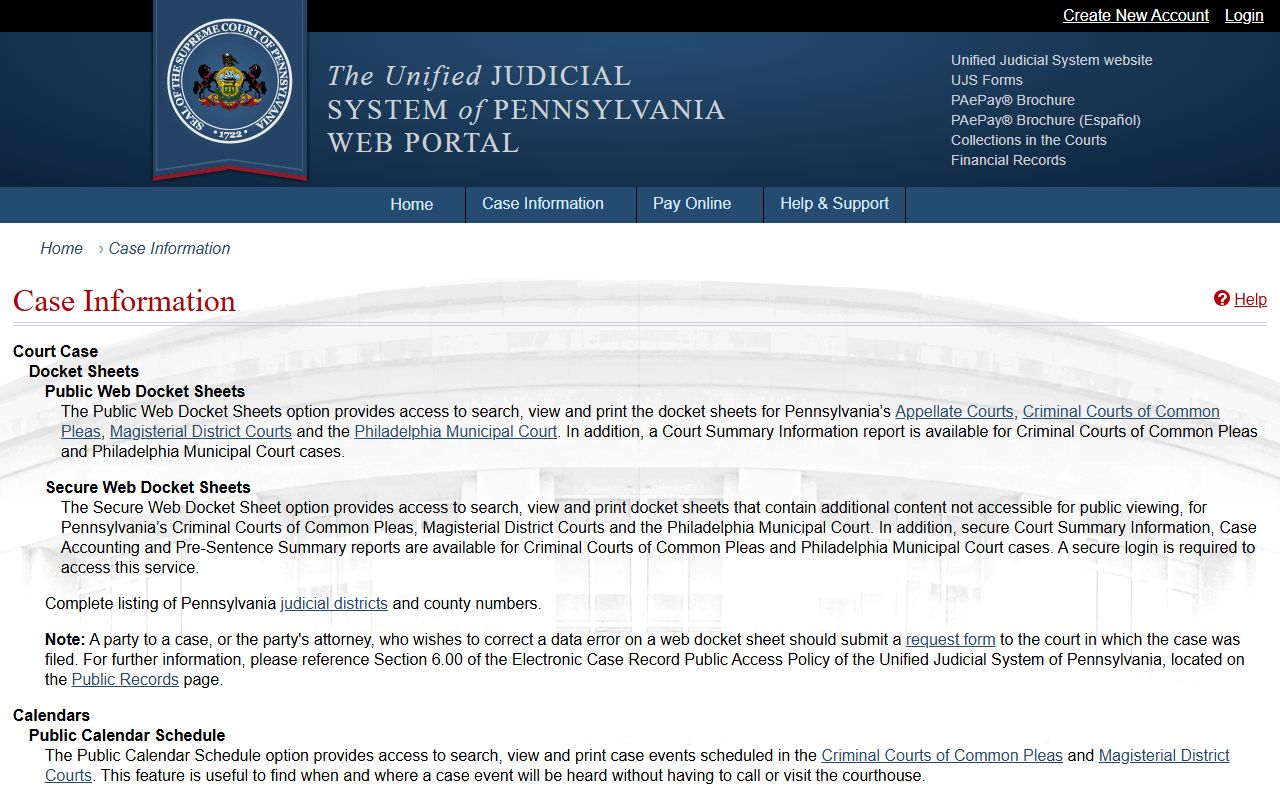
That source also shows why docket search, court calendars, secure access, and payment tools are related but not identical public access channels.
When the record involves money, PAePay may show payment eligibility for fines, costs, restitution, or traffic obligations. The Clerk of Courts payment page notes that limited-access cases can be harder to locate in UJS, and it directs recurring-payment questions to the collections process. For certified copies or document images, use the office that keeps the file rather than relying only on the docket sheet.
Secure docket sheets and public docket sheets are not the same access level. UJS materials separate public docket sheets from secure docket sheets, calendars, and PAePay, which means a public user may see less than a court employee, attorney with authorized access, or office staff member. If a Westmoreland County court docket is needed for filing, appeal review, certified-copy use, or proof of a resolved warrant or payment, confirm the entry with the Clerk of Courts, Prothonotary, Register/Orphans office, or issuing Magisterial District Court before relying on the public screen alone.
Older docket access can also differ from current docket access. The Prothonotary reports that current civil filings are scanned, while older documents may be in docket books or microfilm. The Register reports a similar split for many older probate, marriage, and Orphans' Court records. A missing online docket is therefore not always a missing case. It may be an older index, a paper file, a sealed case, a recent filing delay, or a search run against the wrong court level.